THE CLINICAL PICTURE
Author & Editor
Timothy D. Conwell, DC, FACO, FICC
Double Board Certified - Chiropractic Orthopedics & Medical Infrared Imaging
There is a moment every chiropractic student eventually faces - standing in the exam room, having just completed a thorough history and physical, with pages of clinical findings in hand - and then staring at a blank page, uncertain how to transform everything they have gathered into a report that is thorough, defensible, and actually communicates what they found. That moment - that gap between clinical skill and documented, communicable expertise - is exactly what The Clinical Picture was written to close.
Is This Book Right for You?
The Clinical Picture was written for three distinct groups of healthcare professionals who share a common challenge: the need to perform thorough, evidence-based neuromusculoskeletal examinations and document their findings at the highest standard.
Chiropractic Students
In clinical rotations or preparing for boards
You have studied the anatomy. You have learned the orthopedic tests. But when it comes to performing a complete, systematic examination and then writing a narrative report or SOAP note that would survive clinical scrutiny, nobody has given you a step-by-step framework - until now.
You will walk into your board examination and your first patient encounter with a complete, proven system that covers the entire clinical workup from first question to final documentation.
Residents and New Practitioners
First 1 to 3 years in practice
Claim denials, peer review letters, and insurance audit requests almost always trace back to a documentation failure, not a clinical one. The first years of practice are when documentation gaps cost the most, because the volume is high and the habits are still forming.
You will document medical necessity correctly from day one, produce narrative reports that communicate your findings clearly to every reader, and protect every dollar of revenue your clinical work generates.
Experienced Clinicians
Seeking a documentation upgrade or audit tool
If your current records were pulled for peer review tomorrow, would they hold up against current insurance and legal standards? Most experienced practitioners have never had their documentation systematically reviewed, and the standards have evolved significantly over the past decade.
Use this guide as your clinical audit tool. Identify what is missing. Close the gaps before a carrier, an attorney, or a peer reviewer does it for you.
What This Book Actually Does
Most clinical textbooks teach you one piece of the encounter. An orthopedic examination text teaches you the tests. A documentation guide tells you how to write a SOAP note. A billing manual explains CPT codes. The result is that clinicians end up with fragments of knowledge but no unified workflow connecting the examination to the record to the report to the reimbursement claim.
The Clinical Picture is built differently. It is designed as a single, integrated clinical workflow system that follows the patient encounter from the moment the patient walks through the door to the final signed narrative report and billing code selection. Every chapter builds on the one before it. By the time you complete this guide, you will not simply know how to perform each component of the workup - you will understand how each component connects to every other, and why that connection is the foundation of excellent, defensible clinical practice.
Clinical Confidence
Perform thorough, systematic, evidence-based neuromusculoskeletal examinations with the confidence of a seasoned clinician, regardless of how many years you have been in practice.
Documentation Mastery
Transform your clinical findings into SOAP notes and narrative reports that satisfy insurance carriers, withstand peer review, and hold up as legal documents in medicolegal proceedings.
Revenue Protection
Understand the precise documentation requirements for every E&M service level so your coding is accurate, your medical necessity is defensible, and your claims are paid the first time.
Board Preparation
Master the neuromusculoskeletal examination format and clinical reasoning framework that board examiners look for, with case studies and clinical questions designed to sharpen your diagnostic acumen.
Inside the Book - A Complete Guide to Every Section
The Clinical Picture is organized into five comprehensive sections, each building systematically on the last. Together they cover the complete clinical encounter - from the first question of the medical history to the final line of the narrative report and the selection of the appropriate billing code.
Section I
History and Physical Examination
This is where the clinical encounter begins, and where most errors in practice are made. Section I provides a systematic, evidence-based framework for the complete patient workup, covering every component of a comprehensive history and physical examination in the depth that clinical practice demands.
Chapter 1 - The Examination Outline Guide
A complete, structured outline of the comprehensive history and physical examination, organized to guide the clinician through every required component in the correct sequence. This chapter provides the architectural framework on which everything else in the book is built - the OPQRST pain assessment mnemonic, the full Review of Systems checklist covering 15 body systems, the complete physical examination sequence, and the orthopedic and neurological evaluation protocols.
Chapter 2 - Taking the Complete Medical History
The history and physical examination is the bedrock of medical decision-making in an evidence-based practice. This chapter teaches you how to take a history that captures every clinically relevant detail - chief complaints, history of present illness, pain description using the OPQRST framework, past medical history, family history, social history, occupational history, functional history, and a thorough review of systems. You will learn not just what to ask, but how to record it in a format that communicates clearly and supports your subsequent diagnostic and treatment decisions.
Chapter 3 - The Confidential Medical Patient Questionnaire
A complete patient questionnaire system that systematically captures the medical history before the clinical encounter begins, ensuring that no critical information is missed and that the clinician's time in the examination room is focused on examination rather than administrative history-taking.
Chapter 4 - The Physical Examination
A thorough walkthrough of the complete physical examination, covering general appearance, vital signs, and the systematic assessment of each body system. This chapter emphasizes the documentation of physical examination findings in a format that clearly supports the clinical impression and satisfies insurance carrier documentation requirements.
Chapter 5 - The Neurological Evaluation
Perhaps the most comprehensive chapter in the book. The neurological evaluation is the most critical part of the overall clinical workup for clinicians who treat patients with neuromusculoskeletal conditions, and this chapter covers it in complete, system-by-system depth. You will learn how to perform and document each component of a thorough neurological examination:
- Mental status assessment - level of consciousness, orientation, affect, speech and language
- Cognition testing - memory, attention, concentration, and abstract reasoning
- Cerebral signs - aphasia, agnosia, and apraxia evaluation
- Coordination, gait, and equilibrium - cerebellar testing, Romberg, tandem gait, dysmetria, dysdiadochokinesia
- Cranial nerve examination - all 12 cranial nerves tested in an efficient, clinically organized sequence
- Spinal cord evaluation - pathological reflexes including Babinski and Hoffman, pyramidal and extrapyramidal tract assessment
- Sensory examination - dermatomal and peripheral nerve distributions, cutaneous sensory testing
- Deep tendon reflexes - grading, documentation, and clinical significance
- Motor evaluation - muscle tone, bulk, power, coordination, grading, atrophy, and fasciculation assessment
Dr. Conwell's renowned 3-minute cranial nerve examination sequence is covered here - a technique specifically praised by international reviewers as one of the most clinically efficient and practically teachable approaches to cranial nerve evaluation they have encountered.
Chapter 6 - The Musculoskeletal Evaluation
A complete guide to the orthopedic physical examination, covering visual inspection, palpation, range of motion assessment, and provocative orthopedic testing of the cervical, thoracic, and lumbar spine, the sacroiliac joint, and all major extremity joints. This chapter teaches you how to select appropriate orthopedic tests, how to interpret positive and negative findings in the context of your differential diagnosis, and critically, how to document those findings in a clinically meaningful and legally defensible format.
Chapters 7 and 8 - Clinical Impression and Goal-Oriented Treatment Planning
These chapters bridge the examination and the documentation. Chapter 7 teaches you how to formulate and record a working diagnosis, a clinical impression, and a final discharge diagnosis using appropriate clinical language. Chapter 8 covers the construction of a goal-oriented treatment plan - including short-term and long-term goals, treatment recommendations, time parameters, and the documentation of medical necessity that every insurance carrier requires before authorizing reimbursement. The foundational algorithm of evidence-based clinical practice is made explicit: S + O = A, which dictates the treatment plan P.
Chapters 9 and 10 - Outcome Assessment Tools and Diagnostic Test Criteria
Chapter 9 covers the major outcome and psychological assessment tools used in neuromusculoskeletal practice - the Visual Analogue Pain Scale, the Oswestry Low Back Pain Questionnaire, the Neck Disability Index, the Dallas Pain Questionnaire, and the McGill Pain Questionnaire - including how to administer, score, and document each one. Chapter 10, authored by Dr. Susan L. Vlasuk, DC, DACBR, covers the basic tenets of diagnostic testing including the indications for plain film radiology, MRI, CT, EMG, nerve conduction studies, evoked potentials, and the critical concept of medical necessity as it applies to every diagnostic procedure ordered.
Section II
Clinical Rounds - Spinal and Extremity Disorders
This section brings the examination framework to life through clinical case studies covering common neuromusculoskeletal presentations. Designed to sharpen your diagnostic reasoning and clinical thinking, the case studies walk you through the complete examination algorithm applied to real patient presentations - from the chief complaint through the neurological and orthopedic findings, the differential diagnosis, and the management decision.
The case studies in this section are specifically designed to promote the kind of critical thinking that board examinations test and that complex clinical practice demands. You will be challenged to apply examination findings to differential diagnoses, recognize the significance of neurological patterns, and develop the clinical reasoning skills that distinguish an excellent diagnostician from an average one. These case studies cover both spinal conditions and extremity disorders, including thoracic outlet syndrome presentations and upper and lower extremity neuropathies.
Section III
The Initial Examination and Narrative Report
This section addresses one of the most poorly taught skills in chiropractic education - how to write a complete, professional, legally defensible narrative report. The narrative report is the clinician's primary communication tool with third-party payers, referral sources, attorneys, and the legal system. It is a legal document, a permanent part of the patient's record, and in medicolegal cases, potentially the most critical document associated with a patient's care. Yet most clinicians receive minimal formal training in how to produce one at a high standard.
Chapter 12 - The Report Outline Guide
A structured outline of the complete narrative report, organized so that every required component appears in the correct sequence and nothing essential is omitted. This outline covers identifying data, chief complaints, history of present illness, physical examination findings, impressions and diagnosis, causation, goal-oriented treatment plan, discussion, recommendations, and prognosis - the complete architecture of a professional narrative report.
Chapter 13 - Writing the Narrative Report
A comprehensive guide to the art and science of narrative report writing. This chapter teaches you the principles that distinguish an excellent narrative from a poor one - neutrality, objectivity, clarity, professional language, and the strength that comes from decisive, evidence-based clinical conclusions. You will learn to write the Discussion, the Recommendations, and the Prognosis sections with the specificity and clinical authority that lend credibility to the report and support the patient's case management. Dr. Conwell's rules for quality report writing are presented here - including why certain common phrases weaken a report, how to avoid the appearance of bias, and why the disclaimer "Dictated but not read" beneath a signature can render a report useless as a legal document.
Chapter 14 - Real Narrative Report Examples
This is where the learning becomes immediately practical. Chapter 14 contains complete sample narrative reports and consultation reports from multiple medical specialties, including chiropractic, neurology, physiatry, anesthesiology, and occupational medicine. Every sample report in this chapter meets the CPT code documentation requirements for a 99205 Comprehensive New Patient evaluation - the highest level of E&M service for a new patient. Reading these reports is one of the most effective ways to internalize what excellent clinical documentation looks like in practice, because it shows rather than tells.
Section IV
SOAP Charting and Documentation
The daily SOAP note is the most important document in a clinician's practice. It is a legal document. It is the basis for every reimbursement decision an insurance carrier makes. It is the communication tool that connects every member of the healthcare team involved in a patient's care. And yet, in the words of Dr. Conwell: "The documentation of the daily office visit is often the weak link in the patient's medical record and may lead to mismanagement, medical errors, and poor outcomes."
This section teaches you to document at the highest standard every single visit.
Chapter 15 - The SOAP Note
A complete guide to the four components of the SOAP note - Subjective, Objective, Assessment, and Plan - with specific instruction on what belongs in each section, how to document patient progress using descriptive modifiers, how to record treatment services with the specificity that insurance carriers require, and how to navigate the Evaluation and Management service level requirements for both new and established patients. This chapter covers the complete E&M documentation matrix for CPT codes 99201 through 99215, including the History, Examination, and Medical Decision Making components that determine the appropriate level of service for every patient encounter.
Chapter 16 - SOAP Note Examples at Every E&M Level
Complete sample SOAP notes at every major E&M service level - from a 99212 Problem Focused encounter to a 99215 Comprehensive High Complexity visit - written as they would appear in a real patient record. These examples show you exactly how the documentation requirements translate into practical chart notes, so you can see the difference between a note that supports a high-level service and one that does not, and understand precisely why.
Section V
Orthopedic Tests and Terminology
A comprehensive reference guide to the common orthopedic and neurological tests used in neuromusculoskeletal practice, covering how to perform each test correctly, the anatomical and physiological basis of what each test assesses, the interpretation of positive and negative findings, and the documented clinical evidence for and against each test's diagnostic accuracy. This section also includes a comprehensive medical abbreviations guide - an indispensable reference for both documentation and clinical communication.
As Dr. Conwell and Dr. Lehman emphasize: the ideal orthopedic test would identify dysfunctional tissue without error. No test does that perfectly. Excellent clinical practice requires knowing which tests rule in and rule out which conditions, and how to combine findings from multiple tests into a coherent diagnostic picture. This section gives you that knowledge and shows you how to apply it.
What You Will Be Able to Do After Reading This Book
The measure of any clinical guide is not what you know when you close it, but what you can do when you open the exam room door. Here is what mastery of this material looks like in practice:
- Perform a complete, systematic neurological examination - including all 12 cranial nerves, deep tendon reflexes, sensory testing, motor grading, coordination, and pathological reflex assessment - in a clinically efficient sequence that impresses supervisors and passes board examiners
- Take a comprehensive medical history that captures every element required for a 99205-level E&M service - chief complaints, HPI, past medical and surgical history, family history, social history, occupational history, functional history, and a complete Review of Systems
- Perform and document a complete musculoskeletal examination of the spine and extremities, including orthopedic provocative tests, range of motion assessment, palpatory findings, and postural evaluation
- Formulate and record a working diagnosis, clinical impression, and final discharge diagnosis using appropriate clinical terminology that supports the CPT codes billed
- Build a goal-oriented treatment plan with specific short-term and long-term goals, time parameters, treatment recommendations, and the documented medical necessity that protects reimbursement
- Write a SOAP note that satisfies the Mercy Conference guidelines, supports the E&M level billed, demonstrates medical necessity clearly, and communicates the patient's progress to any reader - including an insurance adjuster who has never been in a clinic
- Produce a complete narrative report that tells the patient's clinical story from first contact to prognosis - written with the objectivity, clinical authority, and professional language that makes it credible to carriers, attorneys, and courts
- Select the correct E&M service level with confidence, knowing that your documentation supports every component of your coding decision
- Interpret and document the findings of diagnostic tests - plain film, MRI, CT, EMG, nerve conduction, and evoked potentials - in a clinically meaningful and medically necessary framework
- Navigate the complete medicolegal documentation requirements for workers' compensation, personal injury, and insurance audit scenarios
What Clinicians and Students Are Saying
"This program will be of benefit to those doctors who want to review and upgrade their exam procedures. It would also be a useful tool for recent graduates reviewing for state board examinations... By presenting the examination procedures and the appropriate charting techniques, Dr. Conwell has provided a much needed learning tool for the profession. The program also incorporates excellent diagrams and artwork to correlate the procedures with the relevant anatomy and physiology being tested."
Stephen Savoie, DC, FACO, Dip. ABCO - Board Certified Chiropractic Orthopedist
Published in Dynamic Chiropractic, Vol. 12, Issue 11
"This multi-sensory lecture series is presented by Dr. Timothy Conwell and is composed of three hour long videos covering the examinations of the central and peripheral nervous systems, as well as the musculoskeletal system. Two aspects of these videos stood out from others that I have viewed. The first is the inclusion of how to combine multiple exams into one short exam. The second is the inclusion of documentation for each type of examination. Many times, that aspect is not addressed in a clinical setting because we may simply check a box and move along. The addition of how to properly document each technique and result provides a more comprehensive lesson for future health care practitioners moving forward. These videos would be a valuable asset to anyone pursuing a healthcare career."
Janet Taylor, RN - MD Candidate, 4th Year Medical Student
Reviewer, TheClinicalPicture.com
"It was one of the best presentations of musculoskeletal assessment I have ever seen. It will certainly influence my assessment procedure in the future. I am impressed by your 3-minute cranial nerve examination. That was the part of the CNS examination which I have always struggled with, but now thanks to your help it became much easier. Your videos have been extremely helpful for me and greatly improved my practical skills."
Dr. Krystain Dawieck - Physiotherapist, Extended Scope Practitioner
Reviewer, TheClinicalPicture.com
"I liked your teaching method and instructional video programs on evaluating the Central and Peripheral Nervous Systems."
K. Nasim, MD - Neurosurgeon
Reviewer, TheClinicalPicture.com
About the Authors
The Clinical Picture was written and edited by two of chiropractic's most credentialed clinical orthopedists, with a combined career spanning more than six decades of clinical practice, postgraduate education, and board examination review.
The Complete Clinical Documentation System
Whether you are preparing for board examinations, entering your first years of practice, or looking to bring your existing documentation up to the highest current standard - The Clinical Picture gives you the complete framework, the clinical examples, and the practical tools to do it.
$59.95 Print | $39.95 Ebook
2nd Edition - Available now on Amazon and TheClinicalPicture.com
Buy on Amazon
Watch Free Videos on YouTube
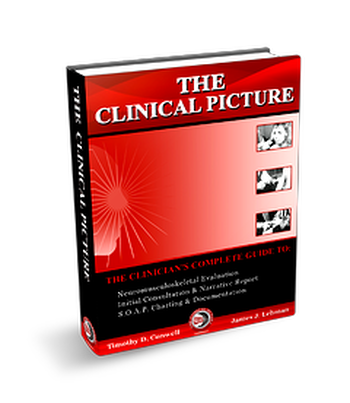
The Clinicians' Complete Guide To:
Neuromusculoskeletal Evaluation - Initial Consultation & Narrative Report - Charting & Documentation
SAMPLE PAGES:
CHAPTER SECTIONS INCLUDE:
|
Central Nervous System Evaluation
Basic Neuroanatomy Cognition, Mental Status, Affect Cerebral Function Cerebellum Function Cranial Nerves Spinal Cord Upper & Lower Motor Neuron Lesions Peripheral Nervous System Evaluation Basic Neuroanatomy Deep Tendon Reflexes Exam Sensory Exam Motor Grading Exam Musculoskeletal Evaluation Spine and Environs Exam Upper Extremity Exam (Shoulder, Elbow, Wrist) Lower Extremity Exam (Hip, Knee, Ankle) |
Basic Tenets of Diagnostic Testing
X-ray MRI CT EMG/NCV Infrared Imaging Initial Report Outline Guide Sections Description Samples of Narrative Reports E&M Coding (new patient) Daily Progress Note Outline Guide to S.O.A.P Note Sections Description Samples of S.O.A.P Notes E&M Coding (established patient) Orthopedic Tests & Medical Terminology Reference Guide |